Practice at home
Golf nets for the backyard: how to pick one by spec
By The Home Golfer editorial team · Last updated July 30, 2026
A backyard net turns any evening into range time: swing after swing, no drive to the course. The catch is that nets vary a lot in what they safely stop, and a cheap one hit with a driver is a broken window waiting to happen. Here’s how to read the specs that matter, an honest word on safety, and five nets compared by their published numbers across price bands.
Three kinds of net
“Golf net” covers three fairly different things. Pick the shape before you pick the brand.
Driving / hitting net
A flat or slightly bowed net on a frame. You hit into it; the ball drops or rolls back. The default backyard net.
Best for: Most yards, most budgets. The simplest thing that works.
Cage / enclosure
A net with a roof and side barriers that surrounds the hitting area, catching sky-balls and shanks the flat net would miss.
Best for: Tighter yards, close neighbours, or if you mishit often enough to worry about it.
Auto-return net
An angled net that funnels the ball straight back to your feet so you can hit shot after shot without walking.
Best for: Rep-heavy practice and repetition drills; usually the pricier, sturdier end.
The specs that actually matter
Netting material and ply. Ply is how many strands are twisted into each cord; more ply means a tougher net. Budget pop-ups use thin single- or low-ply mesh; the sturdier nets run 4-ply to 8-ply, and knotless netting (where the strands are woven rather than tied) spreads impact so the ball drops soft and straight instead of ricocheting. If you hit real balls with a driver, ply is the spec to read first.
Frame. A powder-coated steel or aluminium frame outlasts fibreglass pop-up rods by years. Pop-ups are lighter and cheaper and fine for wedges and irons; steel is what you want if a driver is going in.
Size versus the shot you’ll hit. A 10 ft wide × 7 ft tall face sounds huge until you flare one. Match the face to your worst common miss, not your best strike, and remember a net’s depth(how far the pocket gives) matters as much as its width for absorbing a hot drive.
Safety, honestly
We’re not going to pretend a backyard net is risk-free. A mishit driver launches high and fast, and a thinned or skied shot can clear a 7-ft net entirely; that’s a real ball leaving your yard at speed. No net specification stops a shot that flies over the top of it.
Three honest rules. First, buy taller and wider than you think you need, and favour a cage or enclosure with a roof and side barriers over a flat net if neighbours or windows are close. Second, give the net room to give: leave clearance behind it, because a hot drive pushes the pocket back. Third, if you’re working on your driver in a tight space, dial the swing back or hit into a screen room built for it. A net is superb for irons, wedges and controlled swings; it is not a guarantee against a full-send skull.
Size versus your yard
Measure two things before you buy: how far back you can stand, and what’s behind the net. Radar-style practice wants about 10 feet of ball flight from impact to the net, and you want clearance behind the net so a hot shot doesn’t punch through. A pop-up cage suits a small, enclosed yard where catching mishits matters more than a big face; a wide flat net suits an open yard with a clear backstop. If you’re also measuring distances, the net and your launch monitor share the same footprint; plan the space once.
Cage and enclosure nets with a roof (the ones we would actually recommend near windows) are more often specialist golf stock than Amazon stock, and the same trip gets you practice balls. TGW carries the category if the nets below do not cover your yard.
Five nets, by published spec
Low to high. Prices are approximate 2026 street prices and move over time; the Amazon link shows the live number.
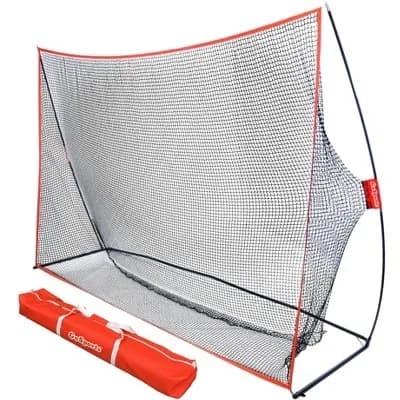
GoSports 10' × 7' Golf Practice Hitting Net
10 ft × 7 ft hitting face on a bow-type frame, indoor/outdoor, includes a carry bag.
Galileo Pop-Up Golf Net (10 ft)
around $90 – $130Cage / enclosure (pop-up)
The budget entry: a pop-up cage with a roof and side barriers that unfolds in seconds. The enclosure shape catches more mishits than a flat net for the money. Fibreglass-rod pop-ups are lighter-duty than a steel frame, so treat it as a starter, not a lifetime buy.
Size: About 10 ft W × 7 ft H × 6 ft D (open)
Netting / frame: Oxford polyester + nylon netting on 11 mm fibreglass pop-up rods, weighted steel base
GoSports 10×7 PRO Golf Net
around $130 – $180Driving / hitting net
A wide, tall hitting face on a real steel frame at an entry price. The 8-ply netting is a meaningful step up from thin pop-up mesh. Flat-net design, so pair it with side coverage or a disciplined swing if your yard is tight.
Size: 10 ft W × 7 ft H hitting area on a bow-type steel frame
Netting / frame: 8-ply net (published as ~2× the strength of the standard GoSports net), powder-coated steel frame
Rukket Haack Golf Net
around $130 – $150Driving / hitting net (ball roll-back)
The popular mid-market pick, endorsed by a college golf coach. Knotless netting spreads impact so the ball drops soft and straight, and the design rolls balls back to you. Assembles in a couple of minutes and packs to a carry case.
Size: 10 ft W × 7 ft H × 3 ft D
Netting / frame: 4-ply knotless netting with a ball roll-back feature
Spornia SPG-7 Golf Net
around $350Cage + auto-return
A full enclosure with an automatic ball-return system that stores 200+ balls and feeds them back, so you can hit continuously. Roof and side barriers make it far more forgiving of mishits than a flat net. The sweet spot between a cheap cage and a fixed installation.
Size: 7 ft L × 7 ft W × 7 ft H plus a 1.5 ft roof; 60 in × 60 in target area
Netting / frame: Reinforced-stitch netting with roof and two side barriers; ~25 lb frame; rated to ~15 mph wind
The Net Return Pro Series V2
around $700Auto-return (premium)
The buy-it-once end. Commercial-grade netting rated for 225 mph impacts and a published 250,000-shot lifespan, with automatic ball return and multi-sport use. Priced like a fixture: worth it only if you will hit into it for years. Note the real room it demands before you order.
Size: 8 ft W × 7 ft 6 in H × 3 ft 6 in D; needs ~10 ft W × 8 ft 6 in H × 14 ft L room
Netting / frame: Commercial-grade UV-treated polyester netting on a 1.5 in aluminium frame; rated to 225 mph ball speed
As an Amazon Associate we may earn from qualifying purchases; it never changes your price. Disclosure.
Related practice guides
More on measuring your numbers and building somewhere to hit them.
- Measure your real distances at homeThe one that everything else depends on: how to get your own carry numbers with a launch monitor, at the range or into a net.
- Golf hitting matsHow to pick a mat by spec: turf construction, sub-surface cushioning, tee options, replaceable strips. Six mats compared by published specs and price.
- Indoor putting greenRoll-out mats, modular greens and custom turf by listed size, stimp speed and price.
Net + launch monitor = a range in your yard
Add a monitor and every shot becomes data
A net gives you swings; a launch monitor turns those swings into carry numbers you can trust. Together they’re a full practice range at home.
Compare launch monitorsOr start with the numbers: how to measure your real distances at home.