
Average 7 iron distance
By The Home Golfer editorial team · Last updated July 29, 2026
The average amateur man carries a 7 iron about 140 yards. That’s the honest middle of the published data: a good player pushes past 150, a slower or newer golfer sits closer to 110, and a PGA Tour pro flies it 172. The 7 iron is the club everyone measures themselves against, so below is every version of the number: by skill, by age, by swing speed, and against the tour. They’re averages. Yours is the one that clubs you, and that you have to measure.
What’s a “normal” 7 iron?
If you just want one number: 140 yards of carry for the average male amateur. But “normal” is a range, not a point. The published amateur data spreads a 7 iron from roughly 110 yards for a beginner to about 165 for a near-scratch player (a 55-yard band, all of it “normal”). The question that actually matters is which end of that band is you, and the tables below are how you find out.
A few things skew the number people quote. Golfers remember their best strike, not their average one, so self-reported 7-iron distances run about a club long. Modern “game-improvement” irons also carry stronger lofts than the clubs these averages were built on (a new 7 iron can be lofted like an old 6), so two players hitting “150 with a 7” may not be swinging anywhere near the same speed. And the women’s average sits well below the men’s here: a typical female amateur carries a 7 iron closer to 100–120 yards, tracking her lower swing speed. None of that is a problem to fix; it’s just a reason to trust your measured number over anyone’s quoted one.
7 iron distance by skill level
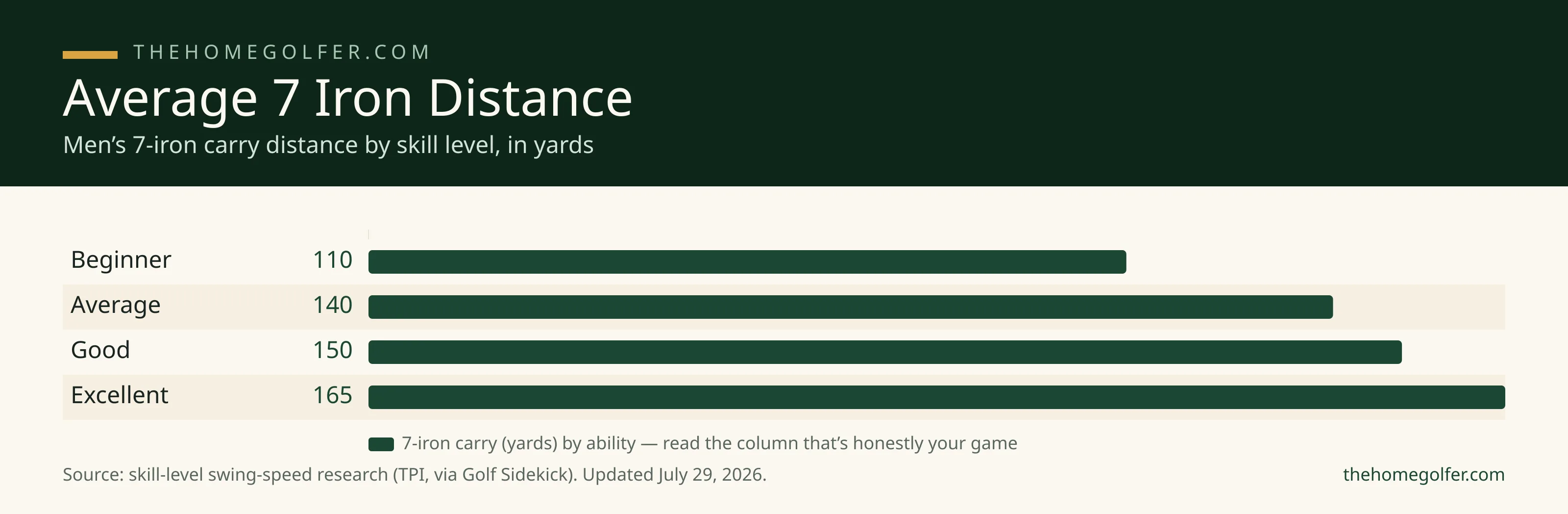
Men’s 7-iron carry across the skill spread, from the same swing-speed research behind our full club chart. Pick the column that’s honestly your game today, not the one you had on your best-ever round.
| Club | Beginner | Average | Good | Excellent |
|---|---|---|---|---|
| 7-iron | 110 | 140 | 150 | 165 |
Source: Skill-level distance chart (Titleist Performance Institute swing-speed research), via Golf Sidekick. How we compile these numbers.
7 iron distance by age
Amateur 7-iron total distance by decade, from tracked-shot data. It fades a few yards each decade as swing speed does, worth knowing before you keep reaching for the 7 on a shot that’s quietly become a 6.
| Club | 20–29 | 30–39 | 40–49 | 50–59 | 60–69 | 70+ |
|---|---|---|---|---|---|---|
| 7-iron | 157 | 152 | 148 | 141 | 129 | 116 |
Source: Amateur iron distances by age (Arccos data), via Golfing Focus. How we compile these numbers.
7 iron distance by swing speed
If you know your 7-iron clubhead speed, this is the most direct read of all. Note the speed here is the iron’s own number, usually about 85 to 90 percent of your driver speed, not the same figure.
| 7-iron swing speed (mph) | Carry |
|---|---|
| 70 | 120 |
| 75 | 132 |
| 80 | 145 |
| 85 | 158 |
| 90 | 170 |
| 95 | 180 |
Carry in yards, at typical launch and spin. This is 7-iron clubhead speed, usually about 85–90% of your driver speed, not the same number.
Source: Driver swing-speed-to-distance chart (derived from TrackMan averages), ProYardages. How we compile these numbers.
Tour reference
The number everyone quotes and almost no one hits: a PGA Tour player carries a 7 iron about 172 yards, an LPGA pro about 139. They get there on clubhead speed and centered strike, not a magic club. Read it as a ceiling, not a target.
| Club | PGA carry | PGA total | LPGA carry | LPGA total |
|---|---|---|---|---|
| 7-iron | 172 | 181 | 139 | 147 |
Source: TrackMan Tour averages (2024 season), via ProYardages / Golf Monthly. How we compile these numbers.
Carry vs. total
The skill and swing-speed tables above use carry, how far the ball flies before it lands. The by-age table uses total, which adds the roll after it hits. For an iron the gap is small, usually well under ten yards, because a 7 iron lands steeply and stops. That’s exactly why the 7 iron is such a clean club to measure yourself with: carry and total sit close together, so one honest number tells you most of what you need.
Why the 7 iron is the reference club
Ask a fitter for one club to test with and it’ll be the 7 iron. It sits in the middle of the set, so its numbers scale predictably up to the wedges and down to the long irons. Nail the 7 and the rest of the bag falls into gapping around it. It flies high enough to show launch and spin clearly on a monitor, but it’s short enough that most golfers can strike it repeatably, which makes the data honest. And because everyone owns one and everyone quotes it, the 7 iron is the common yardstick: “how far do you hit your 7?” is really “how far do you hit it?”
For the same reasons, the 7 iron is the club to start a home measuring session with, and the one to check first if your gapping ever feels off. When you’re ready to see the whole set in context, our full golf club distance chart lays out every club, driver through lob wedge, from the same published data.
Related charts
Other distance charts built from the same published datasets.
- Golf club distance chartAverage carry distance for every club, driver to lob wedge, with tour, skill-level, and by-age tables. Printable.
- Average driver distanceHow far amateurs drive it by handicap and age (Arccos, Shot Scope), next to the 2026 PGA TOUR and LPGA averages.
- Hybrid golf club distancesA hybrid goes as far as the iron it replaces. Here's the manufacturer's own loft-equivalence mapping, brand-by-brand loft ranges, and why we don't print an invented average table.
- Wedge distance chartPitching, gap, sand and lob wedge carry for amateurs and tour players, typical lofts, and the 4 to 6 degree gapping rule.
- Beginner golf club distancesWhat a new golfer actually carries, driver through wedges, with the average-amateur column alongside. Why gapping matters more than yards at this stage.
- Senior golf club distance chartIron distances by age decade from Arccos tracked-shot data, senior columns first. How much distance drifts, why, and the one-club adjustment that fixes most of it.
- Women's golf club distancesDriver distances for female amateurs by handicap band, from two independent 2026 datasets, plus the LPGA Tour club-by-club reference. An honest note on what's still not citable.
- Golf swing speed chartDriver swing speed to distance, average speeds by handicap, age, and sex, plus the shaft flex each speed band points to.
These are averages. Yours is different.
Go measure your real 7 iron
A chart can’t club you correctly. A launch monitor and one range session can. Here’s exactly how to measure your distances at home, starting with the 7 iron.
How to measure your distances