
Golf club distance chart
By The Home Golfer editorial team · Last updated July 29, 2026
How far does each club go? Below are average carry distances for every club in the bag, from published launch-monitor data, tour pros first, then real amateurs by skill level, sex, and age. Read them for what they are: a starting point. The only distances that matter for your club selection are your own, and those you have to measure.
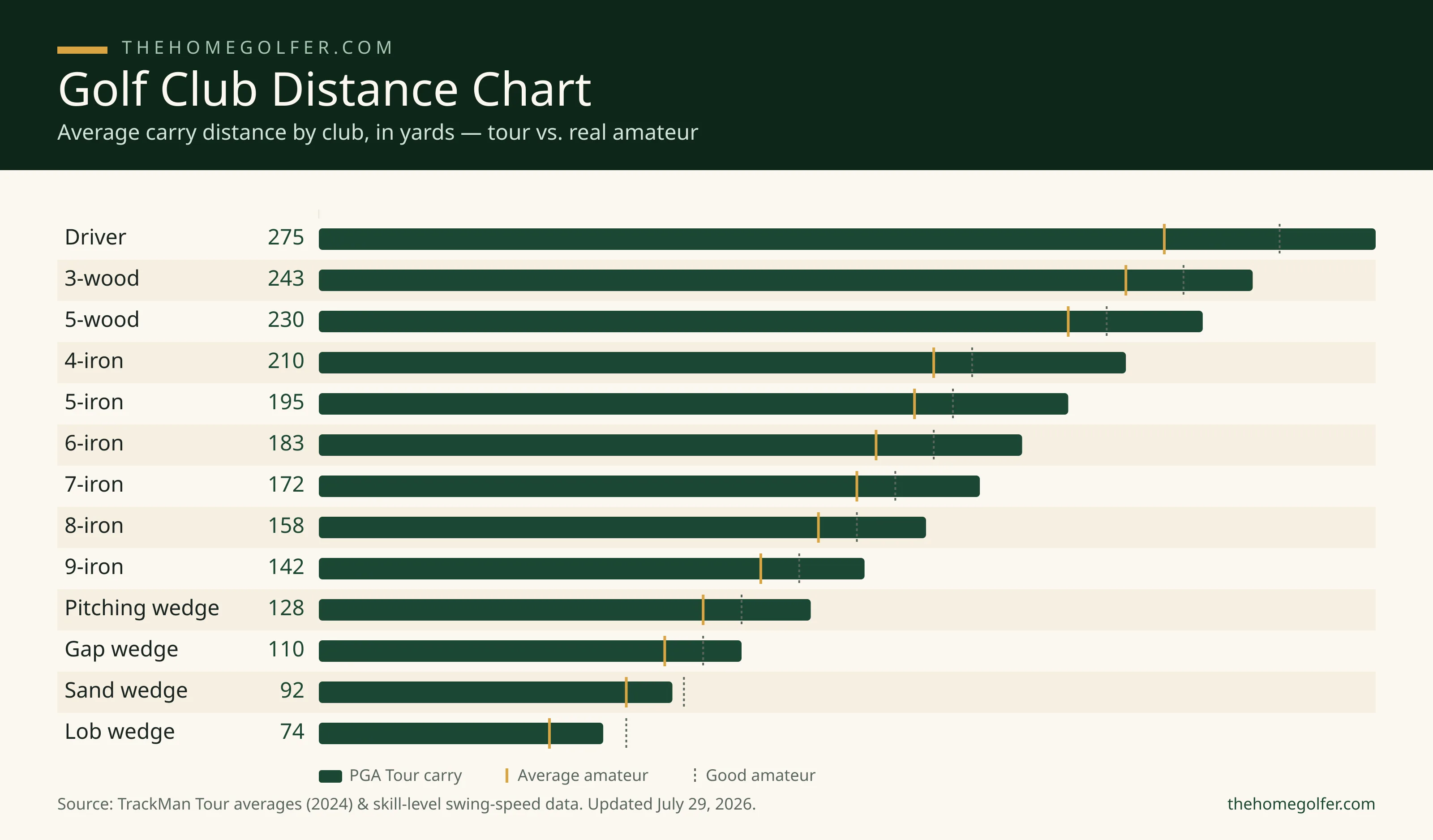
Tour averages (PGA & LPGA)
These are the numbers everyone quotes. They’re from TrackMan’s 2024 Tour data, the fastest, most consistent swings on earth. Useful as a ceiling, not a target: a PGA Tour player carries a 7-iron 172 yards because they swing it about 90 mph. Most of us don’t.
| Club | PGA carry | PGA total | LPGA carry | LPGA total |
|---|---|---|---|---|
| Driver | 275 | 290 | 218 | 230 |
| 3-wood | 243 | 255 | 195 | 205 |
| 5-wood | 230 | 240 | 180 | 190 |
| 4-iron | 210 | 220 | — | — |
| 5-iron | 195 | 205 | 160 | 170 |
| 6-iron | 183 | 193 | 150 | 159 |
| 7-iron | 172 | 181 | 139 | 147 |
| 8-iron | 158 | 166 | 127 | 134 |
| 9-iron | 142 | 149 | 114 | 120 |
| Pitching wedge | 128 | 134 | 101 | 107 |
| Gap wedge | 110 | 116 | 87 | 92 |
| Sand wedge | 92 | 97 | 72 | 76 |
| Lob wedge | 74 | 78 | 57 | 60 |
Source: TrackMan Tour averages (2024 season), via ProYardages / Golf Monthly. How we compile these numbers.
Men’s distances by skill level
Closer to home. This is a carry-distance chart for male golfers by ability, from a genuine beginner to an excellent, near-scratch player, built from swing-speed research. Find the column that’s honestly you, not the one you wish were you. The four scoring clubs, with lofts and gapping, have their own wedge distance chart.
| Club | Beginner | Average | Good | Excellent |
|---|---|---|---|---|
| Driver | 180 | 220 | 250 | 280 |
| 3-wood | 170 | 210 | 225 | 235 |
| 5-wood | 150 | 195 | 205 | 220 |
| Hybrid | 145 | 180 | 190 | 210 |
| 3-iron | 100 | 170 | 180 | 205 |
| 4-iron | 100 | 160 | 170 | 195 |
| 5-iron | 120 | 155 | 165 | 185 |
| 6-iron | 120 | 145 | 160 | 175 |
| 7-iron | 110 | 140 | 150 | 165 |
| 8-iron | 100 | 130 | 140 | 155 |
| 9-iron | 90 | 115 | 125 | 145 |
| Pitching wedge | 80 | 100 | 110 | 135 |
| Gap wedge | 60 | 90 | 100 | 125 |
| Sand wedge | 55 | 80 | 95 | 115 |
| Lob wedge | 40 | 60 | 80 | 105 |
Source: Skill-level distance chart (Titleist Performance Institute swing-speed research), via Golf Sidekick. How we compile these numbers.
Women’s distances
The LPGA column in the tour table above is the best-published women’s reference: an LPGA pro carries the driver about 218 yards and a 7-iron about 139. A typical female amateur lands well below that. Shot Scope’s amateur data puts a mid-handicap woman’s driver carry around 150–175 yards and her 7-iron around 100–120. We now have a dedicated women’s distances page with 2026 driver data by handicap band from two independent datasets; we’re still holding the full club-by-club amateur table until it can be publicly sourced, rather than padding it with estimates.
Reference: LPGA figures in the tour table (TrackMan 2024); amateur ranges from Shot Scope amateur data.
Iron distances by age
Distance fades with age, mostly because swing speed does. This is amateur iron data (total distance) split by decade, so you can see the drift and pick a realistic column. If you’re 55 and still clubbing off the 20–29 row, that’s a lot of short approaches.
| Club | 20–29 | 30–39 | 40–49 | 50–59 | 60–69 | 70+ |
|---|---|---|---|---|---|---|
| 3-iron | 196 | 191 | 186 | 177 | 163 | 145 |
| 5-iron | 173 | 169 | 164 | 156 | 143 | 131 |
| 7-iron | 157 | 152 | 148 | 141 | 129 | 116 |
| 9-iron | 138 | 133 | 130 | 123 | 112 | 100 |
| Pitching wedge | 121 | 116 | 114 | 107 | 98 | 87 |
Source: Amateur iron distances by age (Arccos data), via Golfing Focus. How we compile these numbers.
Carry vs. total, and why it matters
Carry is how far the ball flies before it lands. Total adds the roll after it hits. Most of these tables use carry, because carry is what clears the bunker; roll is a bonus that depends on the fairway, the weather, and luck. When you measure your own numbers, track carry first.
One more warning about every chart on this page: they’re population averages. Your 7-iron might carry 138 or 158. The gap between “about right” and “your number” is usually a green either way, which is exactly why the next step is measuring.

Related charts
Other distance charts built from the same published datasets.
- Average driver distanceHow far amateurs drive it by handicap and age (Arccos, Shot Scope), next to the 2026 PGA TOUR and LPGA averages.
- 7 iron distanceThe reference club, in depth: what a normal 7-iron number looks like by skill level, age, and swing speed.
- Hybrid golf club distancesA hybrid goes as far as the iron it replaces. Here's the manufacturer's own loft-equivalence mapping, brand-by-brand loft ranges, and why we don't print an invented average table.
- Wedge distance chartPitching, gap, sand and lob wedge carry for amateurs and tour players, typical lofts, and the 4 to 6 degree gapping rule.
- Beginner golf club distancesWhat a new golfer actually carries, driver through wedges, with the average-amateur column alongside. Why gapping matters more than yards at this stage.
- Senior golf club distance chartIron distances by age decade from Arccos tracked-shot data, senior columns first. How much distance drifts, why, and the one-club adjustment that fixes most of it.
- Women's golf club distancesDriver distances for female amateurs by handicap band, from two independent 2026 datasets, plus the LPGA Tour club-by-club reference. An honest note on what's still not citable.
- Golf swing speed chartDriver swing speed to distance, average speeds by handicap, age, and sex, plus the shaft flex each speed band points to.
These are averages. Yours are different.
Now go get your real numbers
A chart can’t club you correctly. A launch monitor and one range session can. Here’s exactly how to measure your distances at home.
How to measure your distances