
Golf swing speed chart
By The Home Golfer editorial team · Last updated July 30, 2026
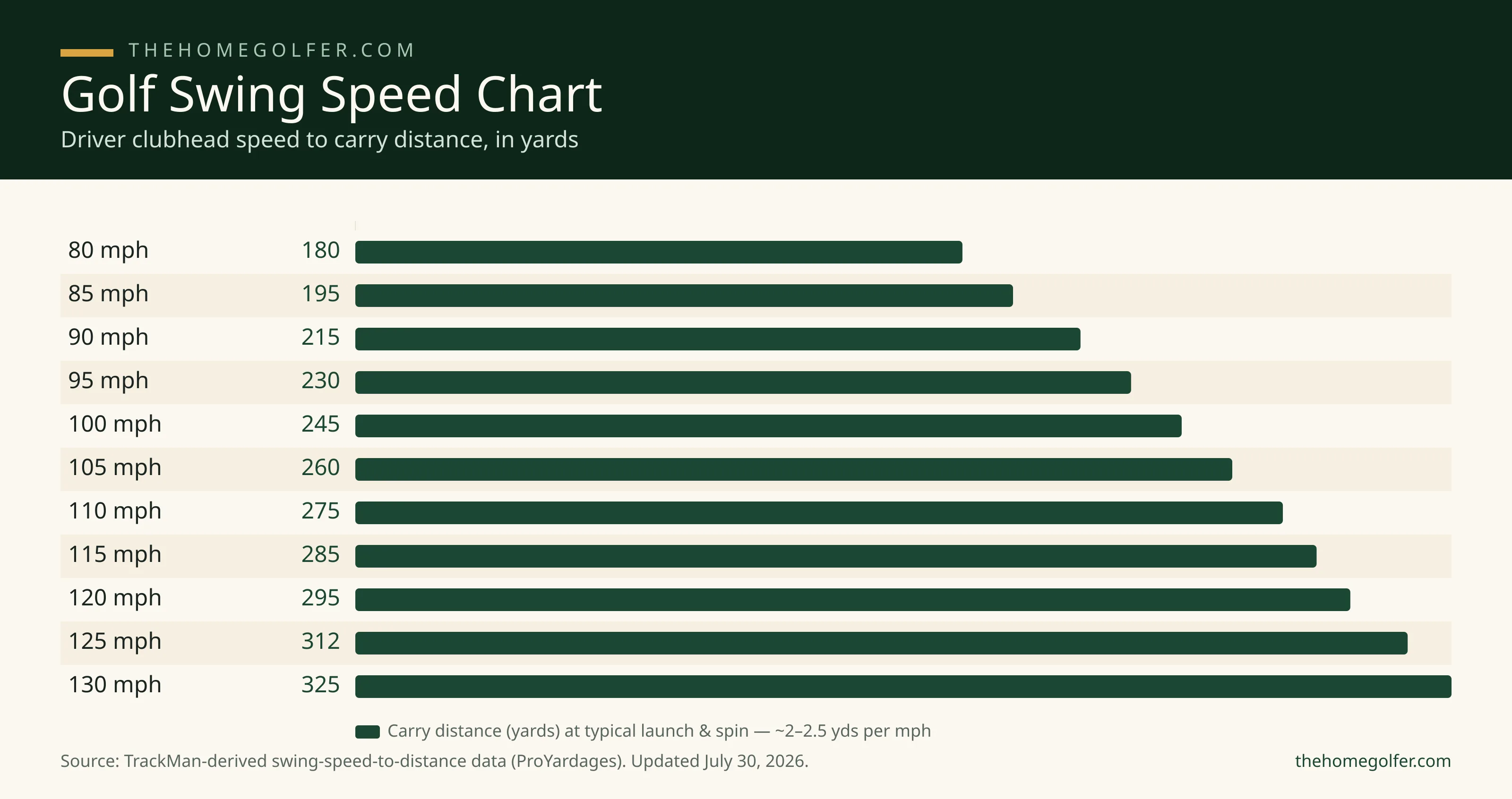
Swing speed is the engine behind distance: with a driver, every extra mph of clubhead speed is worth roughly two to two and a half yards of carry. Below are the charts golfers actually look for: speed to distance, the average speeds by handicap and age, and which shaft flex a given speed points to. They’re a starting point built from published data. The one speed that matters for your setup is your own, and that you have to measure.
Driver swing speed to distance
This is the “how far should I hit it” table. Find your driver clubhead speed on the left and read across for a realistic carry and total. The slope is the well-documented TrackMan relationship: about 2 to 2.5 yards of carry per extra mph, so the jump from 90 to 100 mph is worth roughly 30 yards of carry, not the 60 the range-ball crowd promises. Total adds the roll after landing, which the fairway and the weather decide, not you. For what golfers actually drive it by handicap and age, see the average driver distance chart.
| Driver swing speed (mph) | Carry | Total |
|---|---|---|
| 80 | 180 | 195 |
| 85 | 195 | 210 |
| 90 | 215 | 230 |
| 95 | 230 | 245 |
| 100 | 245 | 260 |
| 105 | 260 | 275 |
| 110 | 275 | 290 |
| 115 | 285 | 300 |
| 120 | 295 | 312 |
| 125 | 312 | 328 |
| 130 | 325 | 342 |
Carry/total in yards. Driver only. Figures are averages at typical launch and spin; your own numbers depend on strike, launch angle and conditions.
Source: Driver swing-speed-to-distance chart (derived from TrackMan averages), ProYardages. How we compile these numbers.
Average swing speed by handicap
Where do you actually sit? The average male amateur (a 14 handicap) swings the driver about 94 mph, not the 110-plus you see on tour. Scratch players reach about 110. If your number is in the 80s, you have plenty of company; most golfers never crack 100.
| Handicap | Driver swing speed (mph) |
|---|---|
| Scratch or better | 110 |
| 5 | 101 |
| 10 | 95 |
| 14.2 (average male amateur) | 94 |
| 20 | 92 |
Driver clubhead speed, mph. Handicaps are USGA index bands.
Source: Average driver swing speed by handicap (TrackMan data), via Golfing Focus. How we compile these numbers.
By age and sex
Speed peaks in the twenties and drifts down a few mph a decade after that, mostly as flexibility and strength fade. It’s a slow decline, not a cliff. A fit 60-year-old often keeps most of their old speed. Use the row that’s honestly you, then measure to confirm it.
| Age | Men (mph) | Women (mph) |
|---|---|---|
| 20–29 | 100 | 72 |
| 30–39 | 97 | 70 |
| 40–49 | 94 | 68 |
| 50–59 | 90 | 65 |
| 60–69 | 85 | 62 |
| 70+ | 79 | 57 |
Driver clubhead speed, mph.
Source: Average driver swing speed by age and sex (Shot Scope / Arccos / TrackMan data), via GolfLaunchLab. How we compile these numbers.
Shaft flex by swing speed
Swing speed is the first thing a fitter checks when picking a driver shaft. The ranges below come from a real fitting house and give you a sensible default: match your speed to a flex, then let tempo break the tie on a borderline.
| Flex | Driver swing speed (mph) |
|---|---|
| Ladies (L) | Below 72 |
| Senior / A-flex (A) | 72–83 |
| Regular (R) | 84–96 |
| Stiff (S) | 97–104 |
| Extra Stiff (X) | 105+ |
General fitting ranges for a driver. On a borderline, tempo decides: smooth swings go softer, aggressive swings go stiffer. Ranges vary between manufacturers.
Source: Driver shaft flex by swing speed (True Spec Golf fitting data), via GOLF.com. How we compile these numbers.
One honest caveat: flex is not standardized. One brand’s Regular can play stiffer than another’s Stiff, and weight, kick point and length all shift the feel. Treat this chart as a place to start a conversation with a fitter, not a rule. Playing a shaft that’s too stiff for your speed is one of the most common (and most quietly damaging) mistakes amateurs make.
How to find your swing speed
Every chart on this page is a population average. Your real number could sit a full flex above or below the row you’d guess, and that changes both your yardages and your shaft. Three ways to get it, cheapest first:
- Work it back from carry. If you know your driver carry, this page’s speed-to-distance table runs in reverse: a 245-yard carry points to about 100 mph.
- A personal launch monitor. A budget unit reads clubhead and ball speed shot to shot, at home or on the range. It’s the honest number, and it’s what the distance and flex tables above are really asking for.
- A fitting or a shop bay. Any decent fitter or simulator bay will show your speed in a few swings, useful if you’re about to buy a shaft anyway.
However you get it, measure a handful of swings and take the average, not the one screamer you want to believe. Our step-by-step guide to measuring your golf distances at home walks through the gear and the method, and the same session gives you swing speed and carry in one go.
Related charts
Other distance charts built from the same published datasets.
- Golf club distance chartAverage carry distance for every club, driver to lob wedge, with tour, skill-level, and by-age tables. Printable.
- Average driver distanceHow far amateurs drive it by handicap and age (Arccos, Shot Scope), next to the 2026 PGA TOUR and LPGA averages.
- 7 iron distanceThe reference club, in depth: what a normal 7-iron number looks like by skill level, age, and swing speed.
- Hybrid golf club distancesA hybrid goes as far as the iron it replaces. Here's the manufacturer's own loft-equivalence mapping, brand-by-brand loft ranges, and why we don't print an invented average table.
- Wedge distance chartPitching, gap, sand and lob wedge carry for amateurs and tour players, typical lofts, and the 4 to 6 degree gapping rule.
- Beginner golf club distancesWhat a new golfer actually carries, driver through wedges, with the average-amateur column alongside. Why gapping matters more than yards at this stage.
- Senior golf club distance chartIron distances by age decade from Arccos tracked-shot data, senior columns first. How much distance drifts, why, and the one-club adjustment that fixes most of it.
- Women's golf club distancesDriver distances for female amateurs by handicap band, from two independent 2026 datasets, plus the LPGA Tour club-by-club reference. An honest note on what's still not citable.
Charts are averages. Yours are different.
Get your real swing speed and numbers
A chart can’t fit your shaft or club your approach. A launch monitor and one range session can. Here’s exactly how to measure your speed and distances at home.
How to measure at home